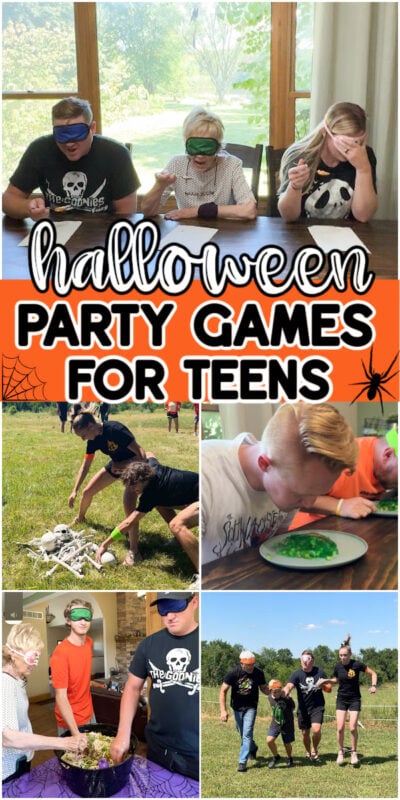
Every Halloween, some families just watch movies and eat candy corn. And then there are the families who go full tournament mode – splitting into teams, competing for points, and finishing the night with prizes. If your crew falls into that second category (or you want to convert them), this list of Halloween party games for teens is exactly what you need.
The setup that works brilliantly here is a Tournament of Terror: divide your group into three teams, run through a series of spooky challenges, award points after each round, and crown the winning team at the end of the night with Halloween prizes to share. The name sounds ominous, but the games are just ridiculously fun. That said, you absolutely don't have to run a full tournament – pick one game, pick five, or play them all. These activities work equally well for Halloween parties, youth group nights, and big family gatherings where kids and adults want to get in on the action.

Build a Skeleton
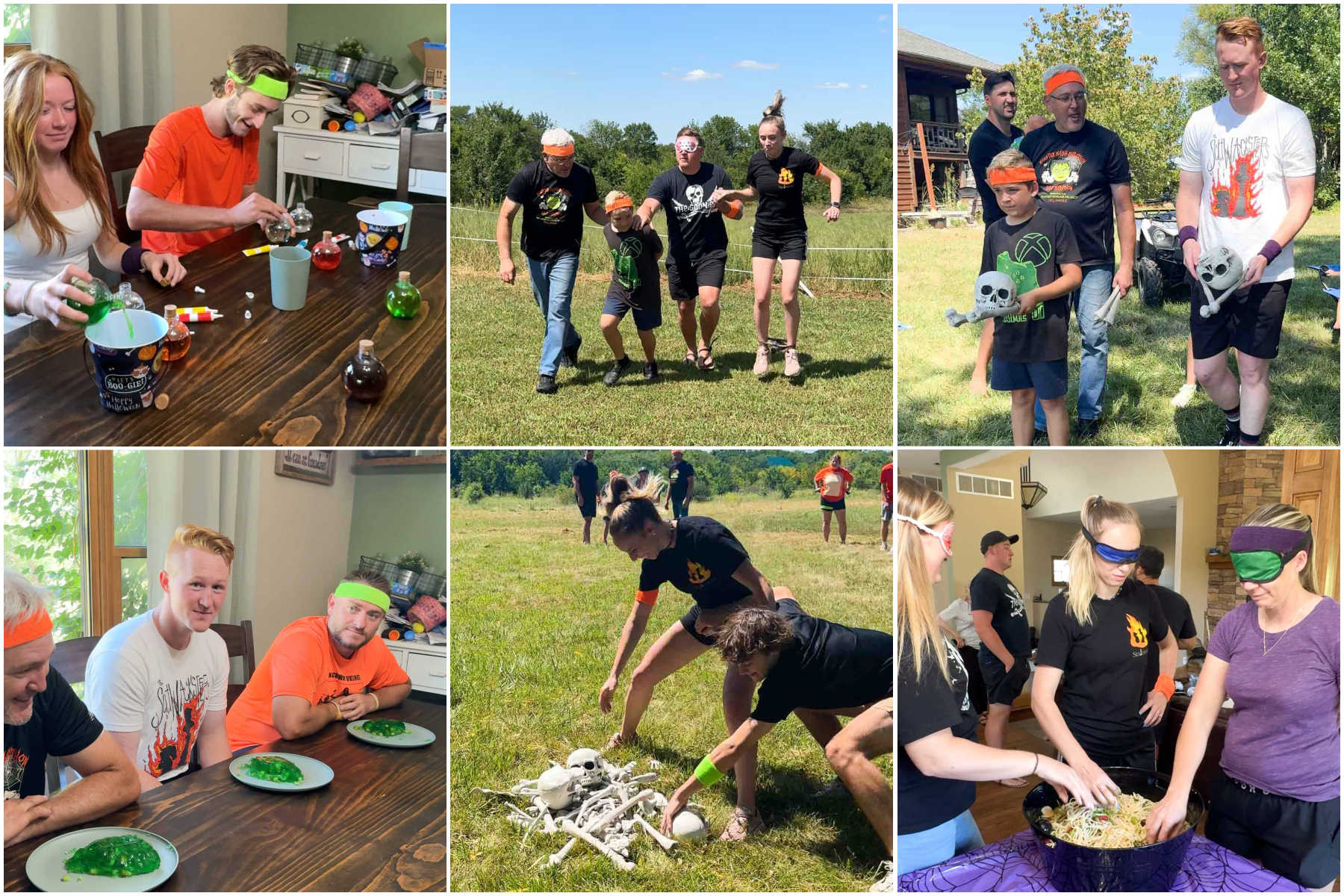
This is the kind of game that sounds easy until someone sprints back to the boneyard for the fourth time because their team keeps grabbing duplicate ribs. Teams race to find the right bones from a shared pile and assemble a skeleton that matches an example laid out across the yard. First team to build it correctly wins the round.
What You Need
- One complete set of plastic skeleton bones per team (the same set can double for several games on this list)
- A large open outdoor or indoor area
How to Set It Up
You'll need three distinct zones in your playing area: a team base on one end (where skeletons get assembled), a boneyard somewhere in the middle, and an example skeleton laid out on the far end. The example doesn't need to be anatomically perfect – a simplified version works fine, especially for ribs and vertebrae. Just make it consistent so all teams are matching the same reference. Add a few extra stray bones to the boneyard to create some confusion, and make sure each team's base is roughly equal distance from the pile to keep things fair.
How to Play
Before the game starts, give all teams one minute to study the example skeleton. Then send everyone back to their base. When you say go, the first runner heads to the boneyard, grabs one bone, and returns. As soon as they're back, the second runner goes. Teams keep rotating in the same order throughout the game.
There's a catch: no hoarding. If a runner brings back a bone the team already has, it goes straight back to the boneyard – no exceptions. At any point, a team member can run to the example skeleton to double-check placement, but that takes precious time. When a team thinks they've finished, they shout check and a referee inspects their work. If something's wrong, they have to figure out the error themselves and fix it. First team with a correctly built matching skeleton wins.
Bone Stick Relay
This relay looks simple from the sidelines. It is not simple. Teams have to transport a skull across the playing area using only long bones – no hands allowed. Balancing a skull between two femurs while running is harder than it sounds, and watching people attempt the handoff is where the real entertainment happens.
What You Need
- Six long bones per team (arm or leg bones from the skeleton sets work perfectly – or substitute actual sticks)
- One skull per team
How to Set It Up
Give each team three pairs of long bones and one skull. Make sure no single team gets all the biggest bones – distribute the femurs evenly so no team has an unfair advantage. Mark three lines across your playing space: one at the start, one at the far end, and one about eight feet back from the far end. That third line serves as a throwing line for the final leg of the relay.
How to Play
Split each team in half, with one half at each end of the playing space. The first player cradles the skull between a pair of bones – no hands touching the skull – and runs to the opposite end to pass it off to their teammate, again using only bones for the transfer. This continues down the line until the final leg. The last runner has to stop at the throwing line and launch the skull across the remaining distance to their teammate. Get the handoff or the toss wrong and you're starting that leg over.
Witch's Brew Dig
Fill a large cauldron or bin with something gloriously disgusting – think cooked spaghetti, peeled grapes, or water mixed with oatmeal – and hide small objects inside. Players have to dig through the brew with their bare hands to find specific items, and they can only use touch to identify what they've found. It's messy, it's chaotic, and teens love it even when they're pretending they don't.

What You Need
- A large bin, cauldron, or bucket per team
- Your choice of gross filler (cooked spaghetti, peeled grapes, slime, or a combination)
- Small items hidden inside each bin (keep the items identical across all teams for fairness)
- A list of items each team needs to find
How to Play
Call out an item from the list. One player per team digs into the brew and tries to pull out the correct object using only their sense of touch – no peeking. First team to hold up the right item earns the point. Rotate players each round so everyone gets a turn in the brew. You can run this as a straight speed competition or award bonus points for finding the most items within a set time limit.
Zombie Obstacle Course
Set up a backyard or gym obstacle course and have players run it in full zombie mode – stiff arms out, slow shuffling steps, whatever your group decides counts as proper zombie form. Add a penalty round for anyone caught moving too fast or breaking character. This one works especially well as a timed relay where teams are racing against the clock rather than each other simultaneously.
What You Need
- Cones, hula hoops, jump ropes, crawl tunnels, or any obstacles you have on hand
- A timer
- Agreed-upon zombie movement rules (establish these before you start)
How to Play
Set the course, agree on the zombie rules, and time each team as they send players through one by one. Add time penalties for rule violations. The team with the fastest combined time wins the round. You can increase the difficulty by adding tasks mid-course – picking up an item, completing a puzzle station, or answering a Halloween trivia question before continuing.

Running the Tournament
If you're going all-in on the tournament format, here's a simple structure that keeps the energy up all night:
- Divide into teams at the start of the evening – three teams works well for most group sizes, but two or four teams are equally manageable.
- Assign a scorekeeper who tracks points after each game. A visible scoreboard (whiteboard, chalkboard, or even a big piece of poster board) keeps competitive energy high between rounds.
- Award points per game – a simple first/second/third structure works fine, or give bonus points for style, sportsmanship, or fastest completion.
- Alternate high-energy games with calmer ones so teams get a short breather without losing momentum.
- End with prizes for the winning team – Halloween candy bags, small party favors, or novelty prizes all work perfectly.
The beauty of the tournament structure is that even if one team dominates the early games, the point system keeps everyone invested until the final round. And if the competition isn't your thing, any of these games stand completely on their own as a single-activity Halloween night. Either way, you're in for a much better evening than another horror movie rewatch.